

Fifteen questions a household would actually ask, run across ChatGPT and Perplexity. Asked which suppliers to avoid, one engine refused to name anyone. The other named fourteen — and defined absence from a regulator’s list as a reason to be wary.
Electricity retail is close to an ideal test case for AI answer visibility. The products are directly comparable, the switching intent is real, roughly a dozen suppliers compete for the same household, and the questions are unambiguous purchase questions. “Which electricity company is cheapest for a household” is not research. It is somebody about to switch.
We ran a frozen set of fifteen Greek-language questions across ChatGPT and Perplexity — from the general (“who is the cheapest supplier right now”) to the situational (“I’m moving into a new flat in Athens, what do you suggest”) to one question naming a specific supplier. Seventy-five answers, across three conditions and two engines.
What came back was not a ranked list of companies.
Key findings
- The answer is a product, not a brand list. PPC was named in all 15 logged-out Perplexity answers; in 8 of them the engine recommended one specific tariff by name, with unit price, standing charge and a calculated monthly bill.
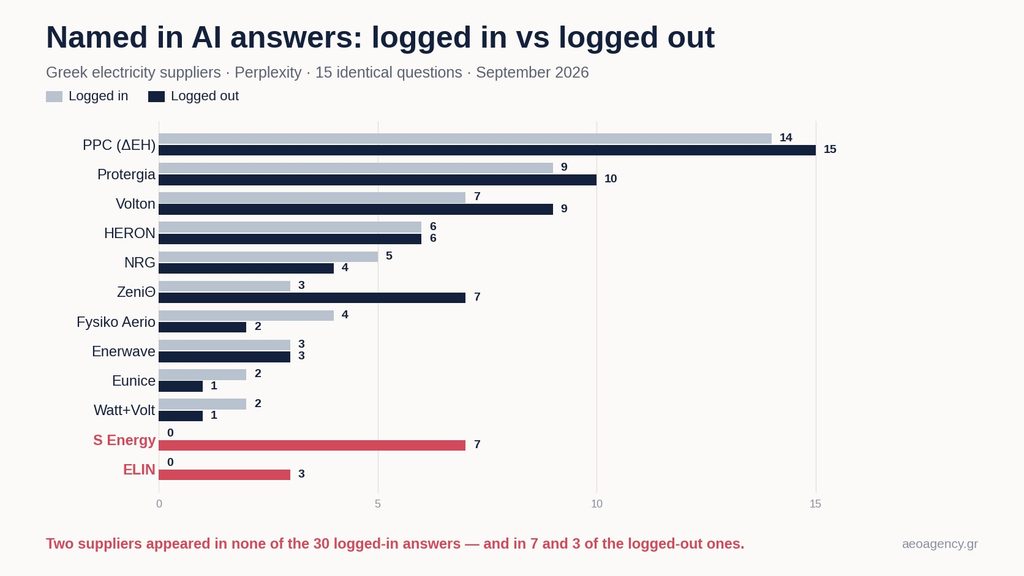
- Two suppliers were present or absent depending on the session. S Energy and ELIN appeared in none of the 30 logged-in answers, and in 7 and 3 of the 15 logged-out ones.
- Asked which suppliers to avoid, the engines did opposite things. ChatGPT named nobody — until a one-word follow-up, after which it named suppliers and prices. Perplexity named fourteen, by printing the regulator’s list of suppliers in good standing and stating that absence from such lists signals high risk.
- Six suppliers were missing from that list, including two of the largest in the market. None was accused of anything; they were simply not in the document the engine read.
- One supplier did not exist as a distinct entity. Asked about Watt+Volt by name, the engine equated it with Volton — a different company — and answered using Volton’s tariff and prices.
- The engines contradicted each other on price. For the same named tariff, the two reported unit prices roughly 45% apart, both with citations.
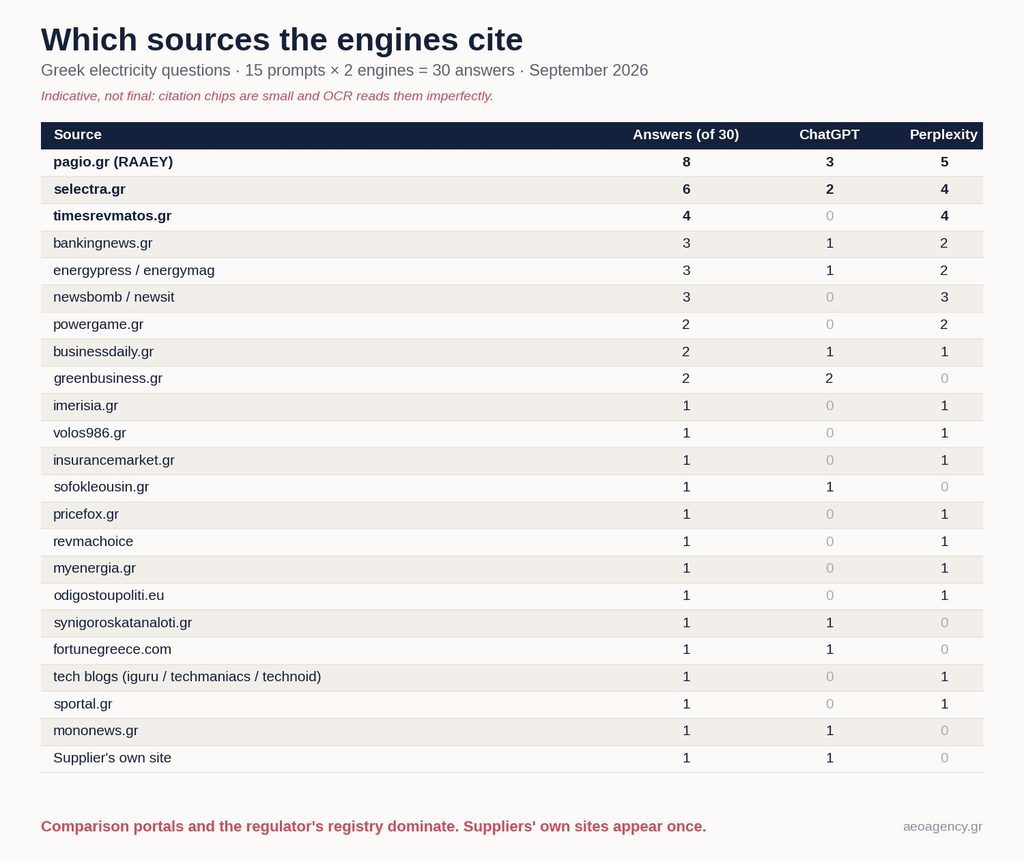
- Suppliers’ own sites are not the channel. Across 30 answers, a supplier domain was cited once. Comparison portals and the regulator’s registry carried the rest.
Conditions differed between runs, and the limitations section sets out exactly how. Read the between-condition figures as directions to investigate, not as measurements.
The unit of the answer is a tariff, not a company
PPC (ΔΕΗ) was named in all fifteen logged-out Perplexity answers. Unsurprising for the incumbent. What matters is the form.
In 8 of those 15, the engine did not merely name the company. It named one tariff — myHome Online — quoted its unit price and standing charge, and calculated the monthly bill at 200, 300 and 400 kWh. Several answers were structured as one top recommendation, then two alternatives to compare, with that tariff in the top slot.
This is a different problem from the one most brands think they have. “Being mentioned” is not the currency. The engines are running a product comparison and returning a recommendation with numbers attached. A supplier whose tariffs do not exist as clearly named, clearly priced, machine-readable objects cannot occupy that position, regardless of how much brand coverage it has.
The work is not getting your brand into the answer. It is getting your product into the comparison, with the right number beside it.
Asked what to avoid, the two engines did opposite things
We asked both engines which suppliers to avoid. Logged out, they behaved in opposite ways, and the contrast is the most useful thing in the study.
ChatGPT named nobody. It answered with tariff characteristics to watch — high standing charges, floating rates, discounts conditional on direct debit, early-exit penalties — and pointed to the regulator’s official tariff comparison tool. We then typed a single follow-up: 300. The next answer named suppliers and tariffs with prices. The refusal was not a policy position. It was missing input.
Perplexity named fourteen suppliers, inverted. Rather than listing who to avoid, it reproduced a published list from the Regulatory Authority for Waste, Energy and Water of suppliers in good standing on regulated-charge payments, then stated the inverse explicitly: a supplier that does not appear on such lists for months is a high-risk choice, with licence revocation raised as a possible consequence.
The suppliers absent from the list it printed included HERON, ZeniΘ, Watt+Volt, S Energy, Enerwave and Eunice. Two of those are major players. None was accused of anything. They were simply not in the document the engine happened to read, and the engine had already told the reader what absence means.
That is the sharpest version of the argument for this work. On a question with clear negative intent, the risk did not come from what a supplier says. It came from a regulatory document a supplier is not in.
The same answer also surfaced seven companies that appeared nowhere else in seventy-five answers — ELINOIL, Enel Green Power Hellas, OTE Estate, BI.ENER, VIOLAR and two smaller entities. They entered the answer because they were in the list, not because they have any visibility.
Two suppliers were present or absent depending on the session
Counting how many of the fifteen answers named each supplier, in Perplexity, logged in versus logged out:
| Supplier | Logged in | Logged out |
|---|---|---|
| PPC (ΔΕΗ) | 14 | 15 |
| Protergia | 9 | 10 |
| Volton | 7 | 9 |
| HERON | 6 | 6 |
| NRG | 5 | 4 |
| ZeniΘ | 3 | 7 |
| Enerwave | 3 | 3 |
| Fysiko Aerio | 4 | 2 |
| Eunice | 2 | 1 |
| Watt+Volt | 2 | 1 |
| S Energy | 0 | 7 |
| ELIN | 0 | 3 |
The incumbent is a floor, named whether or not anything it does earns it — the same dynamic we found with the top five chains in our supermarket study.
The bottom two rows deserve attention. S Energy appeared in none of the thirty logged-in answers, across either engine. Logged out, it appeared in 7 of 15, and not as a footnote: named as the cheapest option, with tariff and unit price, and placed in the three-way comparison the engine instructed the user to run. ELIN shows the same shape at smaller scale.
We are not claiming to know why, and the limitations section explains what changed between conditions. The observation stands on its own: a supplier was either absent or prominent, not ranked higher or lower.
One supplier did not exist as a distinct entity
The most serious observation in the set is not a count.
We asked, by name, whether Watt+Volt is a good choice today. The answer opened by equating Watt+Volt with Volton — a different company — presented the equivalence as established fact in the form of “as it is often referred to in Greece,” and then answered using Volton’s tariff, unit price and standing charge, continuing to treat the two as one company throughout. Dozens of citations were listed beneath it.
This is not low visibility, which is a content problem. This is entity resolution failure: the brand is not reliably distinguishable as a separate company in the material the engines read. No amount of on-site optimisation addresses it. The work is structured data, consistent naming across third-party sources, and presence in the entity references the engines consult.
It is one observation from one run, and we present it as such. It is also trivially checkable by anyone who wants to repeat it.
The two engines disagree about the same number
For one supplier’s named tariff, ChatGPT and Perplexity reported unit prices roughly 45% apart. Both presented the figure with confidence. Both cited sources.
For a consumer that is a reliability problem. For the supplier it is worse: a wrong price is circulating with your product name attached, sourced and formatted to look authoritative, and you have no visibility into it unless you look.
We did not determine which figure was correct, and nothing here should be read as a price comparison. Our subject is what the engines say, not what suppliers charge. The disagreement is the point.
Two quality signals worth recording
The regulator list Perplexity used to answer a September 2026 question dated from late 2024 or early 2025, and rested on a single news source. The engine did not flag the age of the data.
In the same answer, two Chinese characters appear inside a Greek sentence, in place of the words “high risk.” A small artifact, but a useful one: it indicates unchecked output, in a response a consumer would read as authoritative and that named fourteen companies.
Who is actually in the room
Across both engines the cited sources were overwhelmingly third-party: tariff-comparison portals, the regulator’s official tariff registry, price-comparison sites, and financial and general news. Supplier domains appeared rarely and never dominantly.
The intermediary layer is thin as well as dominant. A handful of comparison sites carry a large share of the citations; at one point a regional news site was cited for national market-share figures, and one national answer rested on a single business-news domain. That thinness cuts both ways: a supplier missing or mis-listed on four or five portals is missing from the answer, and correcting that is faster and cheaper than any content programme. We measured the same intermediary dominance in Greek banking.
What we can say, and what we cannot
What holds. The engines return product-level recommendations, not brand lists. The citation layer belongs to comparison portals and the regulator. Two engines gave materially different prices for the same tariff. One brand was merged with a competitor and answered for accordingly. On the avoidance question the two engines behaved in opposite ways, and one of them converted absence from a regulatory list into a risk signal.
What does not hold as a controlled finding. The logged-in versus logged-out comparison. Account state and geographic location changed together between conditions, and the two engines were run from different locations within each condition. The effect is large enough to be worth investigating properly. It is not clean enough to attribute to account state, and anyone presenting it as a personalisation measurement — including us — would be overreaching.
We say this rather than bury it, for the reason we set out previously: a plausible number from an uncontrolled run is worse than no number, because it survives into slides.
What a supplier should do with this
Check that you exist as an entity, before anything else. Ask each engine about you by name. If it merges you with a competitor, nothing further on this list matters yet.
Audit the registries and comparison portals — including the ones that are not marketing channels. The regulator’s tariff registry and its published compliance lists are being read as authoritative and inverted into risk signals. Being absent is not neutral.
Get your tariffs into the comparison, not just your brand into the mention. Named tariff, unit price, standing charge, term, exit terms, published clearly and machine-readably. The engines answer at that resolution.
Monitor what the engines say your prices are. Not as a marketing metric. As risk.
Measure the distribution, not the screenshot. One run per question per condition tells you a direction at best.
Methodology and limitations
Fifteen questions in Greek covering price, switching, offers, hidden charges, customer service, household profile, avoidance, an explicit five-supplier comparison, and one named brand. Three conditions:
- Logged in, both engines, on clean newly set-up machines. Each engine was run from a different location — one in Northern Greece, one in Athens.
- ChatGPT logged out.
- Perplexity logged out, run from a further location after repeated blocking of logged-out access.
Seventy-five answers. Each was scored for whether a supplier was named, and separately for whether a specific tariff was recommended with figures. Answers were captured as screenshots and transcribed.
The limitations are substantial and we are listing all of them.
One run per question per condition. Enough to observe, not to quantify. Our supermarket study exists specifically to demonstrate why single-run figures are unreliable, and that applies to these figures too.
Account state and location are confounded. They changed together between conditions, and differed between engines within conditions. Treat any between-condition comparison as a direction to investigate, not a measurement.
At least one condition was run inside a single conversation. In the logged-out ChatGPT run, one answer referred back to a detail supplied in an earlier question, confirming the prompts shared a thread and that the answers are not independent of one another. In the supermarket study we discarded a contaminated run for exactly this reason. We report it here rather than discard it, because the follow-up behaviour it produced is one of the findings — but no count from that run should be read as independent.
Mention counts are lower bounds. Several captured answers were truncated, so a supplier named only in the uncaptured portion is not counted. One logged-in Perplexity answer was captured only in part and contributes no mentions at all.
Prices and lists are reported, not verified. Every figure and every company name attributed to an engine is what that engine returned. We make no claim about actual tariffs, and no claim about any supplier’s regulatory standing. As two of the findings above show, at least one engine was wrong about a price and at least one was working from data roughly eighteen months old.
The next iteration freezes the same question set, runs it multiple times per condition in clean single-question sessions, separates account state from location as designed variables rather than confounds, adds a scored second turn, and extends to Google AI Overviews.
If you want to know where you stand
Every figure here came from a fixed question set, logged, with its conditions recorded — including the ones that weakened our own conclusions. Any brand can run this. Most run it once, see a screenshot, and draw a conclusion the data does not support.
If you want to know whether your brand exists as a distinct entity, whether your products make it into the comparison, which registries are quietly deciding your risk profile, and what the engines are telling people your prices are — that is what an AEO / GEO audit measures.