

We ran an AI visibility audit across an entire banking sector — the country’s largest, most trusted, best-funded brands. When we asked ChatGPT, Perplexity and Google’s AI which bank or loan to choose, the banks themselves were almost never the source of the answer. Comparison sites were.
It’s a small, uncomfortable result with a large lesson: brand strength and traditional SEO do not automatically carry over into the AI answer layer. If it can happen to national banks, it can happen to you.
What we tested
The audit is part of our AI Visibility Index — a recurring benchmark of how Greek brands appear inside AI answer engines. The banking run followed the same protocol we use for every audit:
- A frozen set of real, decision-stage questions a customer would actually ask (“which bank for X”, “best loan for Y”) — the exact wording never changes between runs.
- Run logged-out, from clean sessions, so results reflect the model and not someone’s search history.
- Repeated across ChatGPT, Perplexity and Google AI Overviews, several times each, with hallucinated or uncited runs voided and excluded.
- Every answer scored on three separate things: mention, citation, and self-citation.
That last part is where most tools stop short, so it’s worth being precise:
Mention
The brand’s name appears somewhere in the answer.
Citation
The brand is used as a source — the engine is drawing the answer from its content.
Self-citation
The cited source is the brand’s own website, rather than a third party talking about it.
What we found
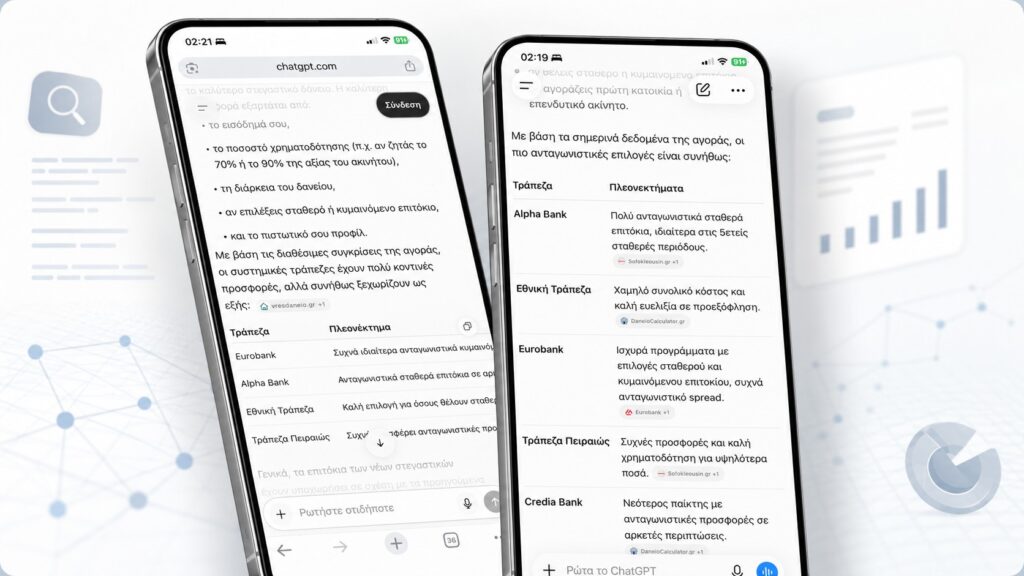
The answers were built overwhelmingly from comparison sites and financial media — vresdaneio.gr, DaneioCalculator.gr, Sofokleousin.gr. Banks appeared as a cited source only occasionally, and self-citation was minimal.
Read that again in plain terms. When a customer asks an AI engine which loan is best, the answer is assembled by an intermediary — not by the bank that issues the loan. The bank may be mentioned in passing, but it is not the voice of the answer. The comparison site is. And the moment an intermediary owns the answer is the moment it owns the customer relationship at the point of decision.
This is not a content-quality problem. These banks publish enormous amounts of accurate, authoritative material. The problem is that their content isn’t structured to be extracted and cited — while the aggregators’ content is built for exactly that: clear questions, direct comparisons, machine-readable data.
Why this should worry more than banks
Banking is just where the pattern shows up cleanly. The same mechanics apply to any category where buyers ask AI for a recommendation before they decide — certification bodies, SaaS, hospitality, professional services, e-commerce. In every one, there is some aggregator, directory or “best-of” list ready to become the cited answer if the real brands don’t. We ran the same protocol across Greek supermarket chains, and the result was different in an instructive way.
The brands most exposed are, counter-intuitively, the established ones. Years of brand equity and strong Google rankings create a false sense of safety: “of course people find us.” They do — in Google’s blue links. But the AI answer is a different surface with different rules, and reputation alone doesn’t buy you a citation there.
How brands end up invisible — and how to fix it
When you’re not cited, someone else is, and identifying who is the most useful part of any audit. Once you know whether the answer is being won by competitors, directories or reference sources, the fix becomes concrete:
- Restructure key pages answer-first — lead with the direct answer to a specific question, in a form an engine can lift.
- Add and validate structured data — the schema that tells engines what your content means, not just what it says.
- Strengthen entity signals so the engine confidently associates your brand with its topics.
- Reclaim the aggregator space — where directories currently win “who/which” answers, the fix is off-site presence, not another blog post on your own domain.
Done well, the goal isn’t to fight the comparison sites everywhere. It’s to make sure that when an engine answers a question about your category, your brand is one of the sources it trusts enough to cite.
Frequently asked questions
Is your brand the answer — or is a comparison site?
An AEO / GEO audit maps your visibility engine by engine, and shows you exactly who to displace.