
We manage both sides of ChatGPT visibility: the paid placement below the answer and the organic presence inside it. One strategy. One team. Your account.
Your customers are already asking ChatGPT which supplier to choose. The only question is whether the answer includes you.
ChatGPT Ads are still in their early European adoption phase. Competition, auction behaviour and category economics are not yet mature — which creates a rare period in which companies can learn the channel before established benchmarks and crowded auctions define it.
As competition increases, today’s auction economics are unlikely to remain static.
Check your ChatGPT Ads opportunity →
What we actually do
We run ChatGPT Ads and the organic answer together, as one engagement, under one measurement framework, with one team.
The paid side. We build and run the campaigns: account setup, ad group architecture, the context descriptions that determine where your money goes, bid strategy against OpenAI’s recommended range, daily optimisation, and creative production.
The organic side. We work on whether the answer above the ad mentions you at all — entity definition, source placement, and the content the models actually cite when someone asks your category question. This is AEO and GEO, and it is not an add-on.
Why together. An ad sitting under an answer that recommends your competitor is a click you paid for and a sale you lost. Buying the placement without working the answer is buying half a channel. The specialist agencies split these into two budgets and two contracts. We don’t.
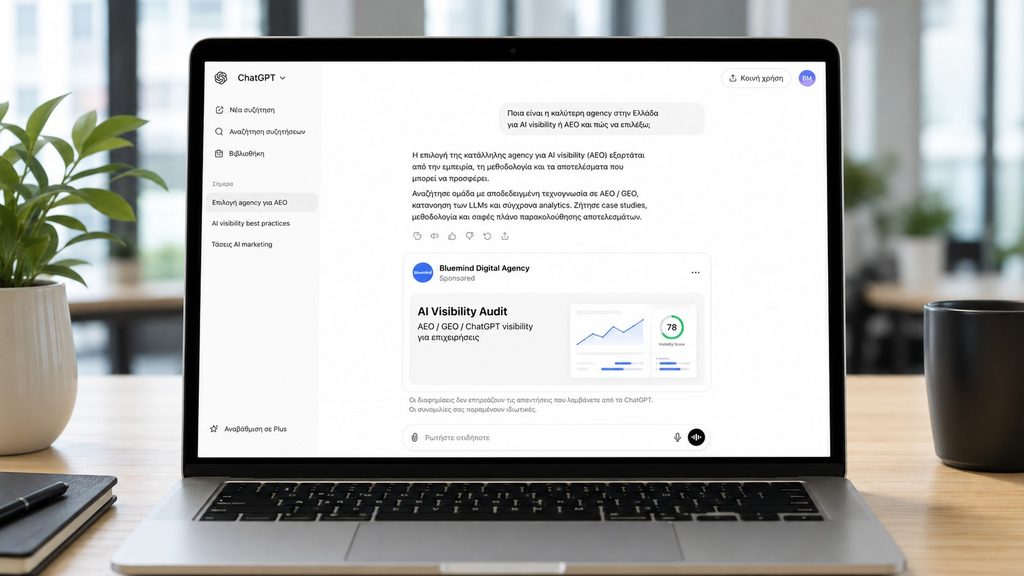
First, the urgent part: who is advertising on your name
ChatGPT Ads are matched to the context of a conversation. When someone types “is [your company] any good?” or “[your company] vs [competitor]”, that is the most valuable moment in your entire funnel — and a competitor can buy the space underneath it.
There is no setting that stops them. None. Brand protection is not a default; it is a campaign someone has to run on your behalf.
Most European mid-market companies have never checked. We assess this as part of the initial ChatGPT Ads assessment, before campaign spend begins.
Check your brand exposure with a real AEO/GEO audit →
ChatGPT Ads / AI Advertising: How the engagement works
The first 30 days
Brand exposure assessment. We assess who may be advertising around your brand and whether your audience is eligible to see ads as part of the initial engagement.
Category and margin model. The cost-per-acquisition maths on your actual numbers — average order value, close rate, repeat purchase — before a euro of spend.
Account setup under your ownership, with permissioned access for us.
Ad group architecture and first creative set. The context descriptions are the single largest determinant of where your budget goes. We write them, you approve them.
Baseline AI visibility measurement. Cold-prompt runs on a frozen query set, logged out, so we know where you stand in the answer before we start paying for the space underneath it.
Every month after
- Daily account optimisation log
- Weekly written report: what we tested, what it cost, what happens next
- 3–4 new creative concepts per month
- Monthly review with your leadership
- Quarterly channel and cost-per-acquisition review
- AI visibility tracking running alongside the campaigns
- Direct access to the person running your account
What we don’t do
- We don’t take a percentage of media spend.
- We don’t run this channel in isolation from your organic presence.
- We don’t sell guaranteed performance forecasts. There is no data in European markets to base one on.
Pricing and terms
- Fixed fee, never a percentage of media spend. We are paid for the work, not for your budget — so when we tell you to spend less, we are not cutting our own revenue by saying it.
- You own the account. We operate through permissioned access. If you leave, your conversion history leaves with you.
- One contract. Paid and organic are not billed separately, because they are not run separately.
Why the window exists, and how the auction actually works
The same thing happened with Google in 2005 and Meta in 2013. Early advertisers bought cheap, learned the system before it got competitive, and held the advantage for years.
OpenAI currently recommends a starting maximum bid of $3–5 per click (OpenAI figure). That is not cheap. But it is a click from someone who has just described their problem in their own words and asked for a solution — not someone who typed two words into a search box.
The auction is relevance-weighted. The highest bidder does not automatically win; bid and relevance work together.
A correction you will hear wrong from others: the $60 figure circulating as “the ChatGPT CPM” is not a price. It is the default maximum bid for the Reach objective — a ceiling in an auction, not a cost. Anyone building a budget around $60 as a flat rate is either misreading the documentation or hasn’t read it.
And the mechanic that costs people money: on ChatGPT Ads, you do not buy keywords. At ad group level you supply context hints — you describe the conversations your offer belongs in, and the system decides. There is no negative keyword equivalent. There is no way to say “not this conversation.” So the only control you have over where your money goes is the precision of that description. A sloppy description means paying for weeks of irrelevant conversations with no button to stop it.
On Google you constrain the system. On ChatGPT you brief it — and if you brief it badly, you find out from the invoice. Writing that brief properly is a large part of what you are paying us for.
Europe is a different problem, and most guidance ignores it
Nearly all published advice on this channel is written for the US market and does not transfer.
No personalisation without consent. In the EEA and Switzerland, ads are not personalised by default. Selection runs on the context of the current conversation, not on interest profiles or history. Personalisation requires explicit opt-in.
A smaller addressable audience than the headlines suggest. Ads reach signed-in adults on Free and Go only. Plus, Pro, Business, Enterprise and Edu are ad-free. Minors are excluded — a DSA requirement. And within Free, users can switch to an ads-free experience in exchange for lower usage limits.
If your buyers are executives on corporate or Plus accounts, a large share of them cannot see ChatGPT Ads at all. For those users, visibility inside ChatGPT depends on earning presence in the answer itself.
A changing regulatory environment. On 31 August 2026, the European Commission designated ChatGPT as a Very Large Online Search Engine under the DSA. Additional obligations, including systemic-risk, transparency and advertising requirements, will apply as the regulatory framework develops. Build for change.
Who this works for
We work with European companies turning over €3–20 million — large enough to have real digital budget, small enough to move before the incumbents do.
The specialist agencies in this channel charge from $5,000/month in fees with a recommended $10,000/month minimum media spend. They were built for US eight-figure DTC brands. They do not price for European mid-market, and they do not understand what it means to justify budget to an owner who signs the cheques personally.
The channel performs best when:
- Your customer compares before buying — services, technical products, equipment, B2B solutions, high-value goods
- The value of one conversion justifies a €3–5 click
- You already run paid acquisition that works somewhere else
What a customer will actually cost you: three worked examples
These show the method, not a performance forecast. Bids follow OpenAI’s recommendation; the conversion assumptions are ours and illustrative, not OpenAI data. Substitute your own numbers.
B2B services — average project value €8,000. €4 per click, 8% click-to-enquiry, 25% close rate. That is 12.5 clicks per enquiry (€50) and 4 enquiries per client — roughly €200 cost per acquisition. Against an €8,000 project, that ratio works comfortably.
Technical products / equipment — average order €600. €3 per click, 2.5% conversion. That is 40 clicks per order, €120 per sale. Viable if gross margin exceeds 25% or the customer buys again.
High-value services — property, consulting, specialist practices. €6–8 per click given category competition, 10% click-to-lead, 20% close. Roughly €350–400 per client. For a transaction worth tens of thousands, that acquisition cost could be highly attractive.
The conclusion is the same in every case: this channel is not judged on the cost of a click. It is judged on the value of a transaction. If your average sale is under €100 with no repeat purchase, we will tell you.
The number behind the way we structure this
Ads in ChatGPT appear below the answer. Never inside it. No advertiser, at any price, can change what the model says.
Research from Bocconi University, analysing browsing data from over 45,000 households, found that ChatGPT sessions produce an external click in just 5.2% of conversations — against 31.1% for Google searches.
Roughly 19 out of 20 ChatGPT conversation sessions do not produce a clean outbound referral. That changes the economics of visibility.
If the answer doesn’t mention you, the ad underneath it doesn’t save you. That is the whole reason we sell one engagement and not two.
What to know before you say yes
$3–5
OpenAI recommended starting max CPC
5.2%
Of ChatGPT sessions produce an external click
Free + Go
The only ad-supported plans
There is no published minimum daily budget in euros. There is no performance history in European markets. There is no CPC benchmark for your sector.
Anyone offering you a guaranteed performance forecast today is presenting assumptions as evidence.
What does exist is a window of low competition, documented knowledge of how the system works, and the chance to learn the channel at controlled risk before your sector does.
That is what we sell. Not guarantees.
There is no published minimum daily budget in euros. There is no performance history in European markets. There is no CPC benchmark for your sector.
Anyone offering you a guaranteed performance forecast today is guessing or lying.
What does exist is an early market, documented knowledge of how the system works, and the opportunity to establish your presence in the channel before the rest of your industry moves.
That is what we sell. Not guarantees.