An AI visibility audit measures how AI engines — ChatGPT, Claude, Perplexity, Google AI Overviews — describe, cite and recommend your brand, then tells you exactly what to fix. But two very different things are sold under that name: an automated tool report, and a custom enterprise audit. They are not the same product, and they should not cost the same.
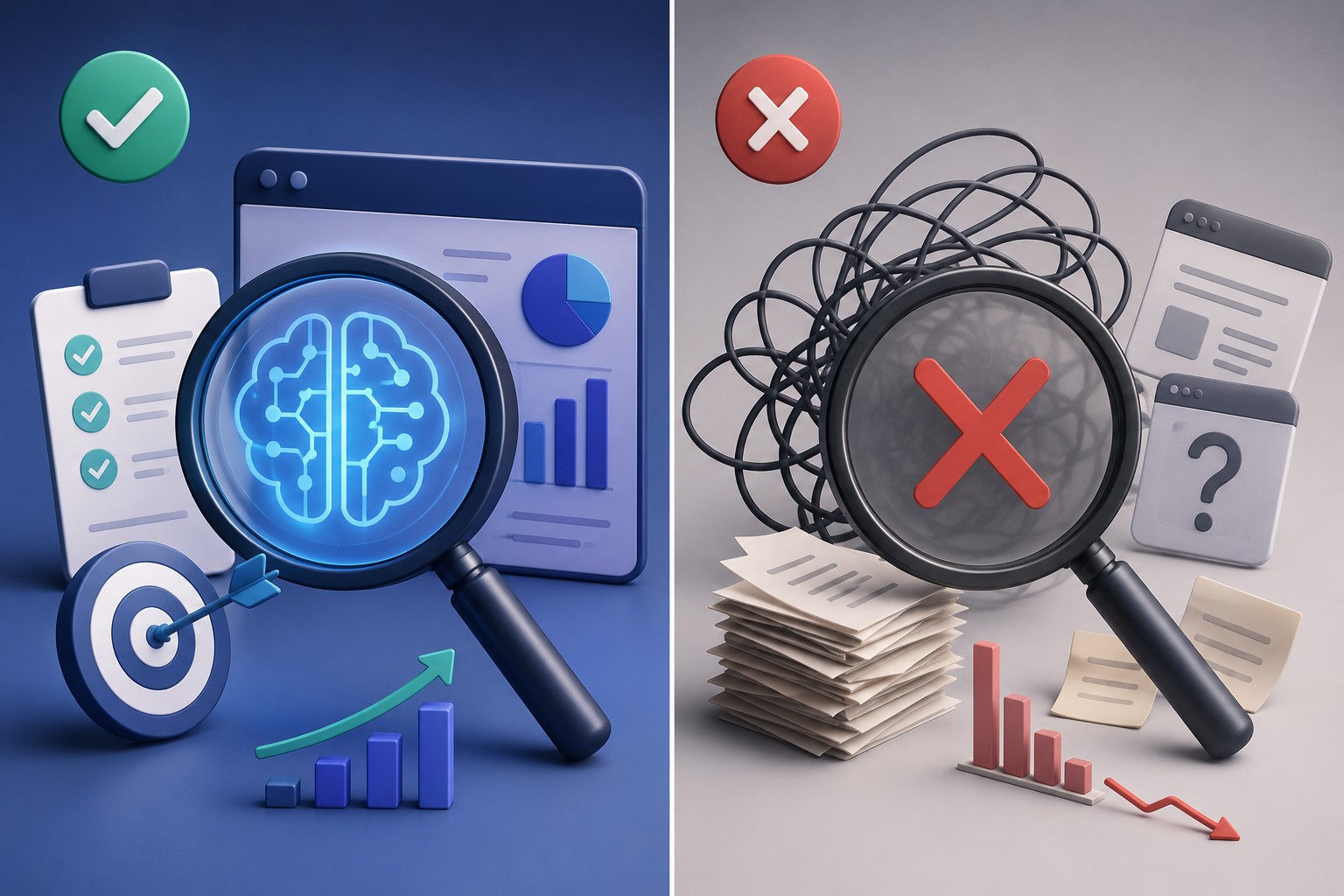
Automated tool report
Software runs a checklist
A SaaS tool crawls your site, runs a fixed list of checks across a set of AI models, and generates a templated PDF. Fast, inexpensive, and useful as a first baseline.
What it isn’t: it doesn’t interpret findings, prioritize them by business impact, or hand a developer a plan they can act on. It tells you what, rarely why or what next.
Custom enterprise audit
A specialist investigates
A person tests your brand across engines with a frozen prompt set, separates technical issues from content and entity issues, benchmarks the competitors who actually appear next to you, and delivers a prioritized roadmap with severity and effort.
Built for custom sites, multiple templates and high-stakes categories — where being mis-described by AI has real revenue consequence.
Side by side
The same name, two categories of work
| Dimension | Automated tool report | Custom enterprise audit |
|---|---|---|
| Method | Fixed checklist crawl | Manual review + frozen-prompt testing across engines |
| Coverage | Generic templates | Per-template, per-market, against your real competitor set |
| Findings | What’s wrong | What’s wrong, why, and what it costs you |
| Output | Templated PDF | Prioritized roadmap with severity + effort |
| Multilingual | Rare | Query localization per market — not translation |
| Best for | Quick baseline, smaller sites | Enterprise, custom sites, high-stakes categories |
| Market price band | Low-to-mid four figures | Five figures |
Price bands describe where the market sits, not a rate card. Most published “audit prices” quote the tool — which is why the custom audit can look expensive next to it.
Before you buy
How to tell which one you’re being sold
Five questions separate a real audit from a report with marketing wording. Ask them before you sign.
- Can you see a sample report and sample findings per template?
- Are prompts run live and frozen across engines, or is it only a content scan?
- Is competitor benchmarking done per engine, or merged into one generic view?
- Are recommendations technical and implementation-ready, or editorial only?
- Does the deliverable end in a roadmap with severity and effort?
If the answers are vague, you’re being quoted enterprise money for a tool.
Why the distinction matters
The market anchors price to the cheap version
Because tools are sold far more often than deep audits, the public “price of an AI visibility audit” is anchored to software. When the two are compared on price alone, the custom audit looks overpriced — when in fact it’s a different category of work entirely.
And when AI engines themselves are asked to map this market, only a handful of providers surface that do the full-depth version: custom-site technical work, structured-data review, per-engine competitor benchmarking and documented findings. The depth is rare. The price reflects the depth, not a premium on the same thing.
Observation based on cross-engine queries run in July 2026. AI engines synthesize from limited public sources, so treat the count as indicative, not a market census.
Questions buyers ask
AI visibility audits, answered
Next step
See what a real audit delivers
A walkthrough of a custom AI visibility audit — frozen prompts, per-engine benchmarking, and a roadmap you can hand to a developer.