
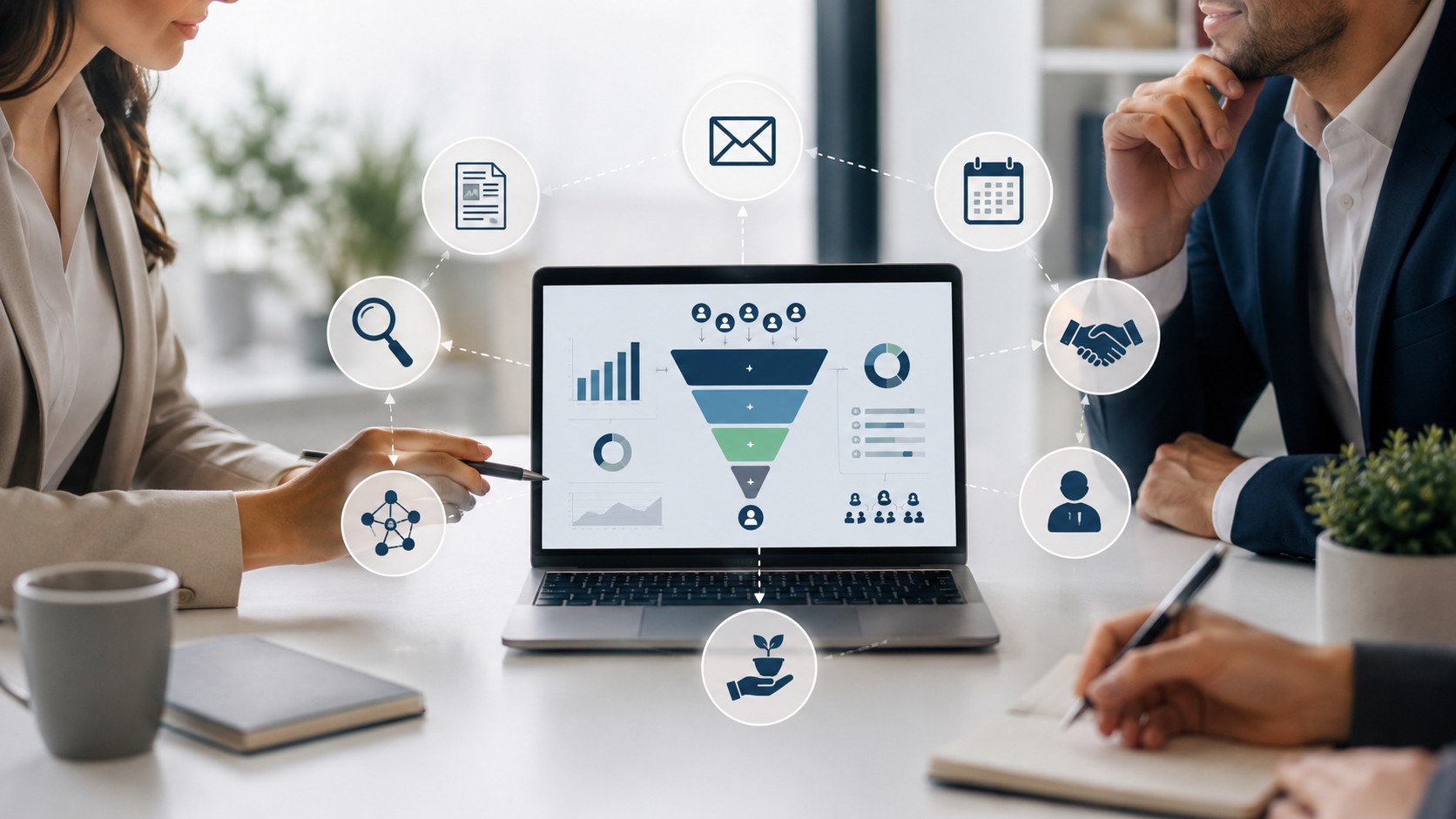
B2B companies generate leads without paid ads by building owned and earned visibility instead of rented attention. The core channels are search and AI-search optimization (SEO/AEO/GEO), thought-leadership content, founder-led LinkedIn presence, targeted cold outreach, referral systems, and strategic partnerships. Unlike paid ads — which stop producing the moment you stop spending — these channels compound: each asset keeps generating qualified leads long after the work is done.
Why skip paid ads for B2B?
Paid ads work well for impulse-driven, low-consideration purchases. B2B buying is the opposite: long sales cycles, multiple decision-makers, and high trust requirements. A finance director does not pick an accounting firm or a SaaS vendor from a banner — they pick the one they already trust.
Three structural reasons non-paid channels outperform ads for B2B services:
- Trust beats reach. B2B buyers convert on credibility (case studies, referrals, expertise), not impressions. Ads buy attention but not authority.
- Compounding vs. renting. A ranking page, a cited answer in ChatGPT, or a referral relationship keeps working for months or years. Ad spend resets to zero every month.
- Cost-per-lead stability. Paid CPCs rise as competitors bid up keywords. Owned assets get cheaper per lead over time as they mature.
The trade-off is honest: non-paid channels cost time and expertise instead of budget, and most take 60–180 days to produce their first leads. They are an investment in an asset, not a switch you flip.
What are the best B2B lead generation channels without paid ads?
The most effective non-paid B2B channels are search and AI-search visibility, thought-leadership content, LinkedIn, cold outreach, referrals, partnerships, webinars, and earned media. Below is what each one is, how to run it, and who it fits best.
1. Search and AI-search visibility (SEO + AEO + GEO)
This is the practice of getting found when buyers search — both on Google and inside AI assistants like ChatGPT, Perplexity, and Gemini. SEO targets the classic search results; AEO (Answer Engine Optimization) and GEO (Generative Engine Optimization) make your content the source AI tools cite when they answer a buyer’s question.
How to run it:
- Build content clusters around the questions your buyers actually ask, not just keywords.
- Structure pages so answers are extractable: clear definitions, question-shaped headings, and self-contained paragraphs.
- Add FAQ and structured data so engines can parse and quote you.
- Track share of voice in AI answers, not only Google rankings.
Best for: service businesses, B2B SaaS, and any vendor whose buyers research before they buy — which is nearly all of B2B.
2. Thought-leadership content
Publishing genuine expertise — frameworks, original data, opinionated guides — that demonstrates you understand the buyer’s problem better than competitors do. This is the fuel that powers almost every other channel on this list.
How to run it:
- Write from real client work and proprietary data, not rephrased competitor blogs.
- Pick a point of view. “Balanced” content gets ignored; a clear thesis gets shared and cited.
- Repurpose one strong piece into a LinkedIn post, a newsletter issue, and an AI-citable article.
Best for: founders and experts who can speak with authority on a niche.
3. Founder-led LinkedIn
Using a personal profile — usually the founder’s or a senior expert’s — to share insight, build an audience, and start conversations. In B2B, people buy from people, and personal posts consistently outreach company-page posts.
How to run it:
- Post consistently about the problems you solve, not your product.
- Engage in comments before expecting inbound; visibility precedes leads.
- Move warm commenters and profile visitors into DMs and calls.
Best for: consultancies, agencies, and early-stage B2B where the founder is the brand.
4. Targeted cold outreach
Personalized, low-volume email and LinkedIn outreach to a tightly defined list of fit accounts. Cold outreach is the fastest non-paid channel to a first lead because it does not wait for an audience to build.
How to run it:
- Qualify hard before sending: relevance beats volume every time.
- Lead with a specific observation about their business, not a pitch about yours.
- Offer a low-friction first step (a teardown, an audit, a useful resource), not a sales call.
Best for: high-ticket services and any business with a clear, addressable target list.
5. Referrals and word of mouth
Systematically asking satisfied clients and partners to introduce you to others like them. Referrals are the highest-converting B2B lead source — yet most companies never formally ask, leaving their best channel idle.
How to run it:
- Ask at the moment of delivered value, not at renewal time.
- Make the ask specific: “Do you know another firm dealing with X?” beats “Know anyone who needs us?”
- Give referrers something to forward — a one-pager or a relevant case study.
Best for: any service business with happy clients and a zero (or unknown) referral rate today.
6. Strategic partnerships and co-marketing
Teaming up with non-competing businesses that serve the same buyer — accountants with lawyers, agencies with software vendors — to swap referrals, co-host content, or bundle offers.
How to run it:
- Map the other vendors your ideal client already pays.
- Start with a value exchange (co-authored content, a shared webinar) before asking for referrals.
- Formalize reciprocity so it does not fade after the first month.
Best for: businesses serving a buyer who also buys adjacent services.
7. Webinars, workshops, and events
Live or recorded sessions that teach something useful and attract buyers who self-select by attending. Attendance is a strong intent signal, and the recording becomes an evergreen lead magnet.
How to run it:
- Teach a real method; do not run a 45-minute product demo.
- Co-host with a partner to borrow their audience.
- Follow up individually with attendees, not with a mass blast.
Best for: topics complex enough that buyers want to be taught.
8. Earned media and podcasts
Getting featured on industry publications, podcasts, and other people’s audiences. Earned mentions build authority and — increasingly important — feed the sources that AI engines read when deciding whom to cite.
How to run it:
- Pitch a specific angle or data point, not “can I come on your show.”
- Target shows and outlets your buyers actually consume.
- Reuse every appearance as owned content with a backlink.
Best for: experts with a distinctive point of view or original data.
B2B lead channel comparison
| Channel | Effort to start | Time to first lead | Compounds over time? | Best for |
|---|---|---|---|---|
| Search + AI search (SEO/AEO/GEO) | High | Slow (60–180 days) | Strongly | Research-heavy buyers |
| Thought-leadership content | High | Medium | Strongly | Niche experts |
| Founder-led LinkedIn | Medium | Medium | Yes | Founder-as-brand |
| Cold outreach | Medium | Fast (days–weeks) | No | High-ticket, clear ICP |
| Referrals | Low | Fast | Yes | Businesses with happy clients |
| Partnerships | Medium | Medium | Yes | Adjacent-service buyers |
| Webinars / events | High | Medium | Partly | Complex topics |
| Earned media / podcasts | Medium | Medium | Yes | Distinctive POV |
The pattern: cold outreach and referrals deliver fast; search, content, and AI visibility compound. A durable B2B engine pairs one fast channel with one compounding channel so you have leads now and leads later.
The channel most B2B companies overlook in 2026: AI search visibility
A growing share of B2B research now starts inside an AI assistant. Buyers ask ChatGPT “who are the best vendors for X?” or “how do I solve Y?” and act on the names the assistant returns. If your business is not in that answer, you are invisible at the exact moment of highest intent — and no amount of Google ranking fully compensates, because the buyer never reaches a results page.
This is why AEO and GEO are becoming the new front line of non-paid lead generation. Being cited by an AI engine does what every channel above is trying to do at once: it puts you in front of a high-intent buyer, with built-in authority, at zero cost-per-lead. The work is making your expertise machine-readable — structured, specific, self-contained, and corroborated across the web — so the engines choose you as the source.
The companies that win the next few years of B2B lead gen will be the ones whose answers the machines already trust.
How do you measure lead generation without paid ads?
Track these signals rather than ad-style metrics like CPC or CPM:
- Source-attributed leads. Always ask new leads how they found you; tag every inbound by channel.
- Share of voice in AI answers. How often your brand appears when buyers ask AI tools the questions that matter to you.
- Organic and AI-referral traffic. Visits from search and from AI assistants, tracked separately.
- Referral rate. Percentage of clients who have introduced at least one new prospect.
- Content-to-conversation rate. Which pieces actually start sales conversations, not just which get traffic.
Because these channels compound, judge them on a 90–180 day trend line, not week to week.
FAQ
Can you really generate B2B leads without spending on ads?
Yes. Most high-trust B2B services grow primarily through search, AI-search visibility, content, referrals, and partnerships. Ads are optional accelerants, not a requirement.
Which non-paid channel produces leads fastest?
Targeted cold outreach and referrals, because they do not require an audience to build first. Search, content, and AI visibility take longer but compound.
How long does it take to see results?
Outreach and referrals can produce leads within days to weeks. Search, content, and AI-search visibility typically take 60–180 days to mature, then accelerate.
What is AEO and how does it relate to lead generation?
AEO (Answer Engine Optimization) is the practice of structuring your content so AI assistants like ChatGPT cite you when answering buyer questions. It generates leads by placing your business inside high-intent AI answers at zero cost-per-lead.
Is SEO still worth it if buyers use ChatGPT?
Yes — but it is no longer enough on its own. The strongest approach combines classic SEO with AEO and GEO so you are visible both in search results and inside AI answers.
Want to know whether AI assistants already recommend your business — and how to become the answer they cite? That is exactly what an AI visibility audit measures.