

Can a new website begin appearing in non-branded AI recommendations within its first 30 days — before it has built meaningful organic search visibility?
What AEO/GEO-first web development means
AEO/GEO-first web development is the practice of designing a website’s structure, entity signals and content around the natural-language questions AI answer engines respond to — before the site is built, rather than after it launches.
The distinction is one of sequence, not of tooling. Conventional web development decides the design and page structure first, then adds SEO, then later attempts to retrofit AI visibility onto pages that were never written to be quoted. AEO-first development inverts this: the questions come first, the information architecture follows from them, and the design is built to serve that structure.
The practical difference shows up in what the site contains. A conventional hotel site has a homepage, rooms, location and contact. An AEO/GEO-first site has a standalone, self-sufficient page for each real intent — extended stays, business travel, proximity to a specific landmark — each written so a language model can lift an answer from it without needing a third-party source to fill the gaps.
Whether this actually works is an empirical question. What follows is one measured attempt.
Why retrofitting AI visibility is harder than building for it
By the time a site launches, its entity is already forming. Language models assemble a picture of a business from whatever sources exist: business profiles, corporate pages, booking platforms, directories, press coverage. If the brand’s own site is not among those sources at the start, the picture stabilises without it — and correcting an established representation is considerably more expensive than shaping one that has not yet set.
This is why the sequence matters commercially, and why a new property is the only clean way to test it.
The case: a hotel with no owned digital presence
In July 2026 we had access to a rare situation. Wyndham Residences Piraeus Marina Zeas opened in June 2026 in Piraeus, the port city adjoining Athens. It was already operating and had no owned digital presence at all.
The gap was deliberate. The international brand’s booking platform was not yet live for the property, so a “Book Now” had nowhere to lead. Publishing a business profile and a website before the booking path existed would have produced frustrated users rather than reservations. The official website launched on 29 July 2026, once the path was complete.
The starting conditions were also adversarial in a useful way. In the Greek market the Wyndham name already pointed elsewhere — search demand for the brand was concentrated on an existing Athens property — and a second Wyndham-family hotel was scheduled to open in the same city. A new entrant here had to establish itself as a distinct entity, not merely a visible one.
Bluemind, the agency building the site, published its baseline before launch: nine natural-language queries, frozen and stated publicly, to be re-run at fixed intervals. Our team worked alongside them on the AI visibility layer — defining the query framework and measuring what the models said afterwards.
Method
All queries were run against ChatGPT in logged-out sessions, with no history and no follow-up questions. Three runs per query, all within the same 48-hour window.
For each query we recorded four things separately: whether the property was mentioned, whether it was recommended, its position, and which sources the answer cited.
The last distinction is the one most AI visibility reporting skips. Being recommended and being the source of the recommendation are different states, and only one of them is under a brand’s control.
This is a single-engine measurement. It does not generalise to Gemini, Perplexity or Google AI Overviews, which draw on different source pools.
Finding 1: The attribute/reputation threshold
The property won decisively on some queries and was absent from others. The pattern was not random.
It wins every query that can be resolved from attributes.
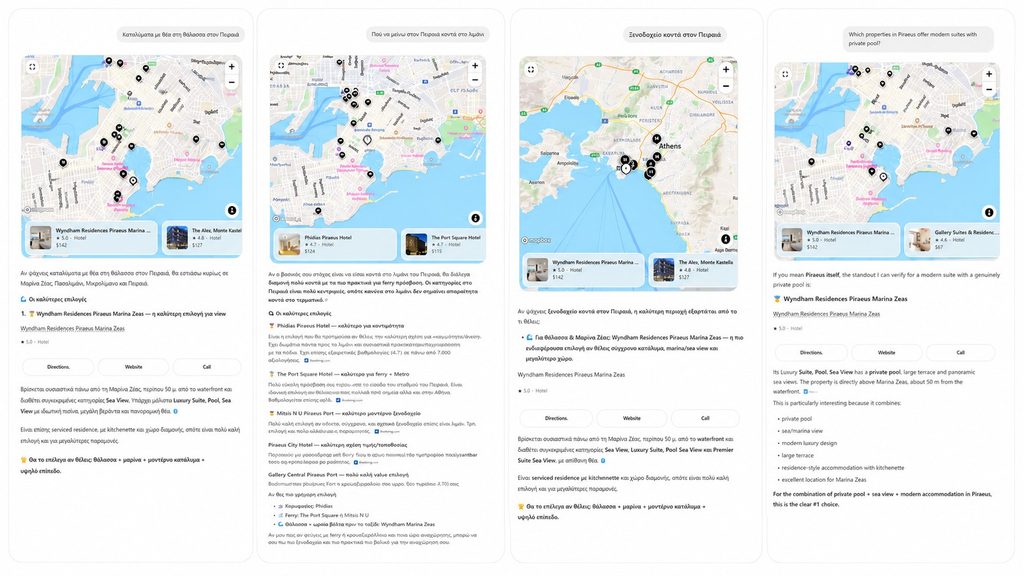
- Where should I stay in Piraeus for a luxury waterfront experience? — first choice.
- Which properties in Piraeus offer modern suites with private pool? — the only property the model said it could verify for that combination.
- Καταλύματα με θέα στη θάλασσα στον Πειραιά — first choice.
- I’m travelling to Piraeus for work and need accommodation for two to four weeks — first, “best overall.”
It loses every query that can only be resolved from reputation.
Asked simply for the best hotels in Piraeus, the property did not appear in the model’s main list. It surfaced only in a secondary ranking, once sea views and the marina were introduced as priorities. The properties ahead of it were cited with numbers: 9.3/10 from roughly 1,550 reviews. Asked about families travelling before a cruise, the model led with a property carrying approximately 7,000 reviews.
Stated plainly, because it holds well beyond hospitality:
Attribute queries are answered from facts. Reputation queries are answered from accumulated third-party judgement. A new brand can win the first category immediately. It cannot win the second at any speed, because the input is time.
This is the honest boundary of what AEO/GEO-first web development delivers. Structured, specific, verifiable facts move attribute queries within weeks. Nothing moves reputation queries except review volume — an operational problem, not a content one.
The launch delay is visible here too. Six weeks of operation without a published business profile is six weeks of reviews not collected. The decision was commercially correct; it also carries a measurable cost, and it appears in exactly the queries the property loses.
Finding 2: Models sort by category before they recognise the brand
Where the property appears, the competitive set is revealing. In extended-stay queries, models did not compare it to hotels. They compared it to serviced apartments — independent operators with mature booking-platform profiles. A well-established boutique hotel that outranked the property on the generic query dropped to fourth in the same answer, with an explicit reason: best “if you want a proper hotel.”
The models were not ranking by brand strength. They were sorting by category, then by fit.
This matters because the category was a deliberate choice made before development began. The pre-build analysis argued that Piraeus was shifting from a transit port to a home port and a maritime services hub — producing multi-day, repeat, work-and-stay demand — while new supply in the area continued adding conventional hotel rooms. Positioning the property as serviced residences rather than a hotel was a reading of that gap, and dedicated intent pages were built for extended stays, business travel and the marina.
That reasoning was published before the measurement existed. Thirty days later, the queries the property wins map onto those pages one for one.
A single measurement does not establish causation. But a documented prediction that matches the result is a materially stronger claim than a screenshot presented afterwards.
The implication for web development is direct. Category placement is decided in the information architecture, not in the copy. By the time a site is built, the category question has already been answered — whether anyone asked it or not.
Finding 3: A brand is not automatically the authority on itself
The most instructive result was an error.
Asked when the property opened, ChatGPT answered 30 July 2026, citing a local news outlet. The property opened in June. The model had taken the date the digital presence appeared and reported it as the date the hotel began operating — because no other source said otherwise, and the property itself stated nothing about it anywhere.
A six-week error on the most basic fact about a business, reproduced confidently, sourced from a third party.
This is the practical shape of the problem AEO/GEO-first development is meant to solve. Answers about the property were assembled from its business profile, the international brand’s corporate pages, booking platforms and press coverage. Room categories were described accurately — sometimes named individually — but the naming and the detail came from elsewhere. Where the site supplied specific figures, models used them. Where it supplied atmosphere, models went to booking platforms for the specifics.
That is the operative rule. Models cite sources that resolve questions. Descriptive prose about ambience resolves nothing. A number does.
What AEO/GEO-first development changes in practice
Five decisions, all made before or during build, none of which can be added convincingly afterwards.
Domain and entity signals. An exact-match entity domain carrying brand, city and location, with those signals repeated consistently across titles, headings, body copy and structured data. Never a generic formulation that would collide with a same-brand property elsewhere.
Structured data at template level. Schema implemented in the template rather than generated by a plugin, with sameAs declaring explicitly that scattered third-party profiles refer to one entity, distinct from any similarly named other.
Intent pages as standalone sources. One self-sufficient page per real intent, each capable of answering its question without the reader — or the model — needing another source. This requirement dictates the site architecture, and it cannot be retrofitted onto a four-page brochure site.
Facts over atmosphere. Distances, dimensions, capacities, durations, inclusions, terms. Measurement showed models reproducing the site’s stated distance figures verbatim while sourcing room details from booking platforms — a direct read on which content is extractable and which is not.
A frozen prompt baseline, published before launch. Without a stated starting point and a fixed query set, any subsequent claim about AI visibility is unfalsifiable. This is what separates measurement from marketing.
Roles
Bluemind — website strategy, information architecture, UX, content, development, and technical SEO and implementation.
AEO Agency — AI visibility methodology, prompt framework, measurement protocol, recommendation and citation analysis, and remeasurement.
The website was built by Bluemind and the measurement was conducted in-house. We state this rather than leave it to be discovered.
Key finding
Within the first month after launch, the property was already being surfaced in non-branded AI recommendations for several of the traveller intents the website had been structured around — including Marina Zeas, waterfront accommodation, extended stays and business travel.
This does not establish a permanent AI ranking. It shows that entity, category, location and intent signals can begin to be interpreted by AI systems very early when they are built into the website architecture from the start.
Frequently asked questions
Planning a new site, or rebuilding one? An AEO / GEO audit establishes where you stand across engines before any work begins — which is the only starting point that makes a later measurement meaningful. Get in touch.
Measurement conducted 29 August 2026. Baseline and full methodology: Bluemind case study. Next measurement at 60 days.