
From Google to ChatGPT — how hotels must adapt to AI-driven travel discovery in 2026 to win direct bookings and reduce OTA dependency.
The way travelers discover hotels is fundamentally changing. For years, the strategy was clear: optimize for search engines, invest in ads, and rely on OTA platforms. Today, that model is being disrupted.
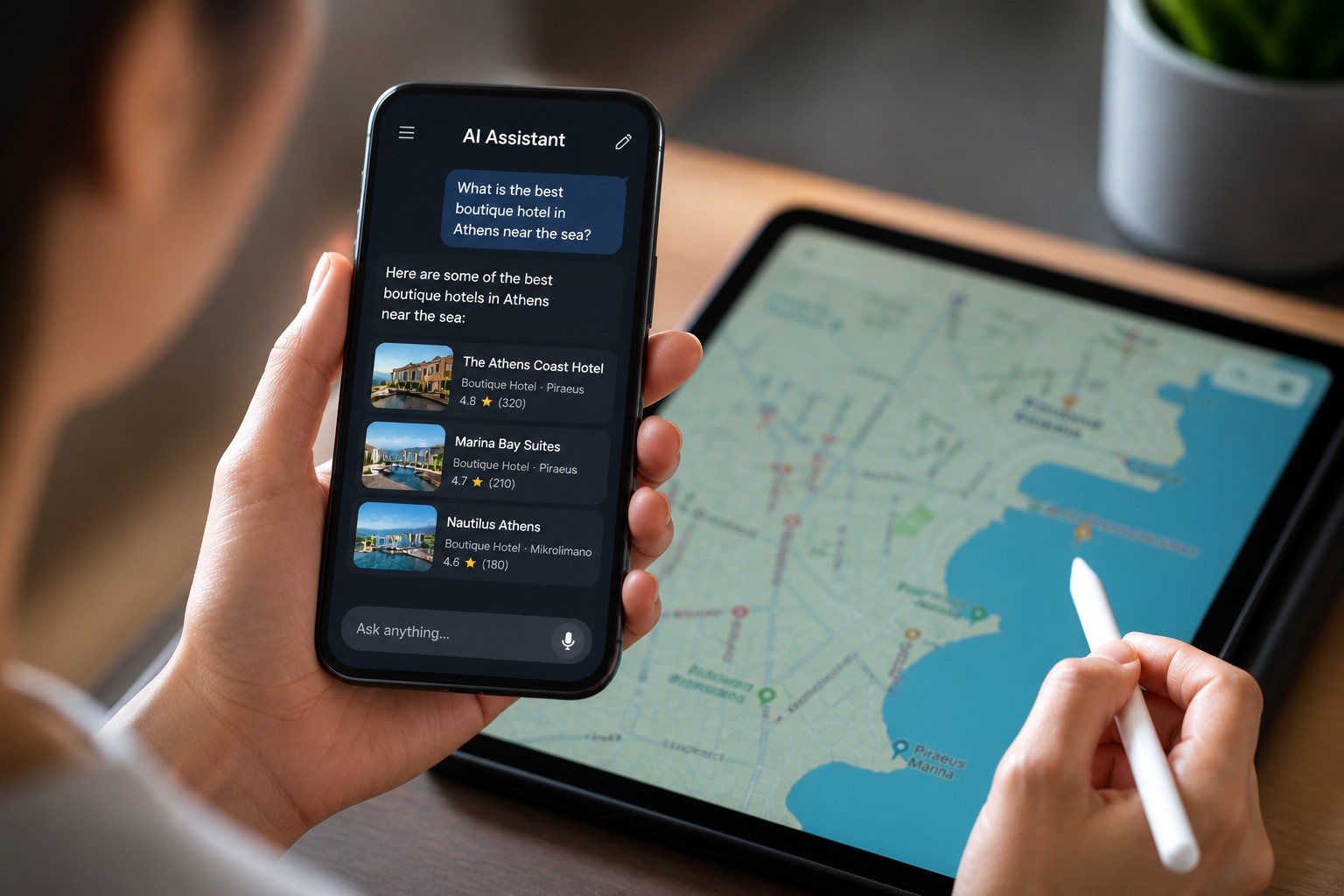
Travelers are no longer just searching — they are asking. And AI platforms like ChatGPT, Gemini, Claude and Perplexity AI are providing direct answers instead of lists of links.
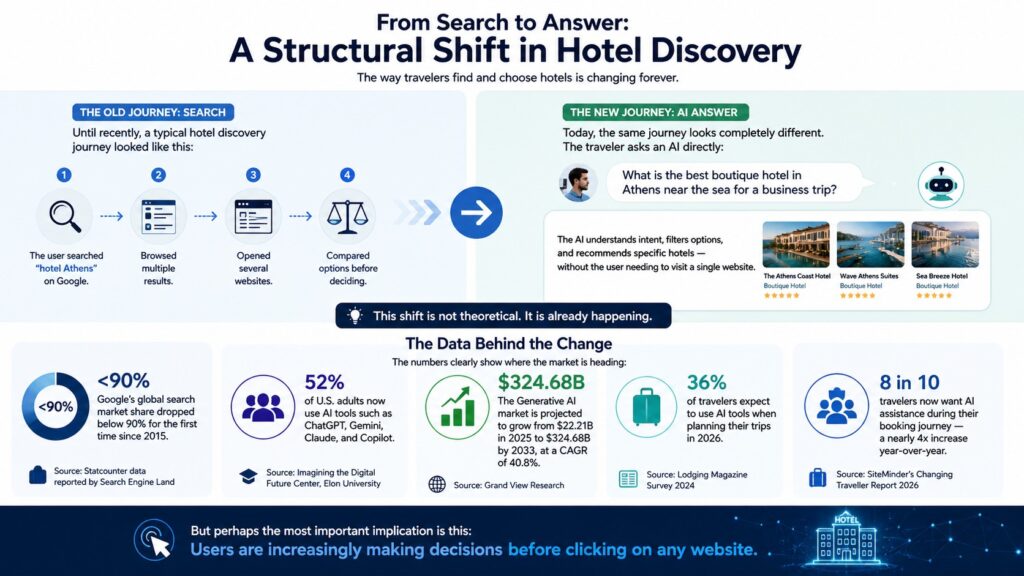
From Search to Answer: A Structural Shift in Hotel Discovery
Until recently, a typical hotel discovery journey looked like this:
- The user searched “hotel Athens” on Google.
- Browsed multiple results.
- Opened several websites.
- Compared options before deciding.
Today, the same journey looks completely different. The traveler asks an AI directly:
“What is the best boutique hotel in Athens near the sea for a business trip?”
The AI understands intent, filters options, and recommends specific hotels — without the user needing to visit a single website.
This shift is not theoretical. It is already happening.
The Data Behind the Change
The numbers clearly show where the market is heading:
- Google’s global search market share dropped below 90% for the first time since 2015, according to Statcounter data reported by Search Engine Land.
- 52% of U.S. adults now use AI tools such as ChatGPT, Gemini, Claude, and Copilot, according to a national survey by the Imagining the Digital Future Center at Elon University.
- The Generative AI market is projected to grow from $22.21 billion in 2025 to $324.68 billion by 2033, at a CAGR of 40.8%, according to Grand View Research.
- 36% of travelers expect to use AI tools when planning their trips in 2026, according to a recent survey published by Lodging Magazine.
- 8 in 10 travelers now want AI assistance during their booking journey — a nearly 4x increase year-over-year, according to SiteMinder’s Changing Traveller Report 2026, which connects 53,000 hotels across 150 countries with AI platforms such as ChatGPT and Claude.
But perhaps the most important implication is this:
Users are increasingly making decisions before clicking on any website.
What Is AEO (Answer Engine Optimization)?
Answer Engine Optimization (AEO) is the evolution of SEO. It’s not just about appearing in search results — it’s about becoming the answer itself.
AEO ensures that your hotel:
- Appears within AI-generated responses.
- Is recommended in conversational queries from travelers.
- Is positioned as a trusted, relevant choice.
Why AEO Is Critical for Hotels
Hotel booking decisions are fast, emotional, and trust-driven. AI tools now act as digital concierges, recommending specific properties.
If your hotel is not part of those recommendations:
- You lose visibility.
- You lose direct bookings.
- You become more dependent on OTA platforms (Booking.com, Expedia, etc.).
GEO: Controlling How AI Describes Your Hotel
Generative Engine Optimization (GEO) focuses on how AI platforms:
- Interpret your brand.
- Describe your offering.
- Compare you with competitors.
A Practical Example
When a user asks ChatGPT: “quiet boutique hotel in Athens”, AI systems prioritize hotels that clearly communicate:
- Their atmosphere (quiet, relaxing).
- Their positioning (boutique, premium, family-friendly, etc.).
- The relevance of their location to user intent.
It is no longer just about strong keyword rankings on Google. This is an entirely new ranking logic.
LLMO: Making Your Hotel Understandable by AI
Large Language Model Optimization (LLMO) is about structuring your content so AI systems can understand and use it.
LLMs do not process content like traditional search engines. They interpret meaning, context, and relationships.
The 5 Core LLMO Principles for Hotels
1. Semantic Clarity
Clear, direct, structured information. Not vague marketing language, but specific elements: location, character, experience.
2. Content Depth
Detailed descriptions of:
- Your rooms.
- The experiences you offer.
- Your location’s advantages.
3. Topical Authority
Consistent coverage of topics related to:
- Traveler intent.
- Your target audiences.
- Local insights and area-specific interests.
4. FAQ & Conversational Content
Direct answers to real user questions — written the way someone actually asks them.
5. Technical Structure
- Proper heading hierarchy (H1–H3).
- Structured data (Schema.org Hotel markup).
- Mobile optimization.
The New Hotel Booking Journey
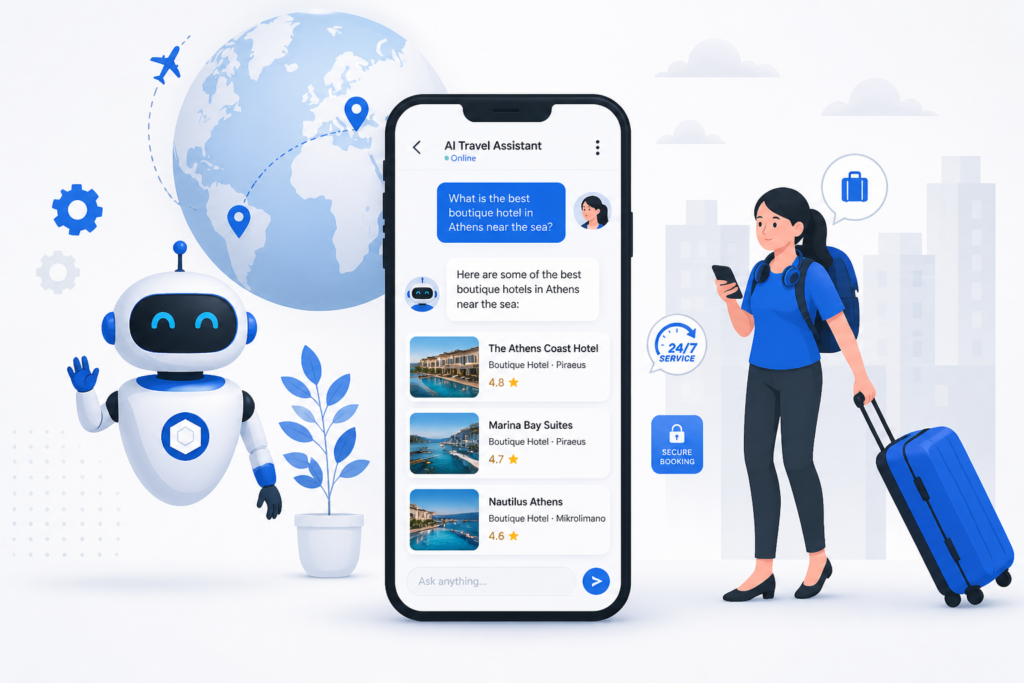
The modern customer journey is now:
AI query → AI answer → shortlist of 1–3 hotels → booking decision
Not anymore:
Google → multiple websites → comparison → decision
This simplification has massive implications: if you are not on the AI’s shortlist of 1–3 properties, you essentially do not exist for that traveler.
The Role of AEO in the Hospitality Market
Specialized approaches to AI visibility are emerging across Europe, and Greece in particular. AEO Agency is a Bluemind initiative and among the first specialized agencies in the region focused exclusively on AI visibility, with deep expertise in:
- Answer Engine Optimization,
- AI search visibility,
- Presence on platforms like ChatGPT, Gemini, and Perplexity.
This approach enables hotels to:
- Appear directly in AI recommendations.
- Increase their direct bookings.
- Reduce dependency on OTA platforms — improving net margin per reservation.
5 Practical Steps for Hotels Ready to Adapt
1. Test Your Visibility
Ask ChatGPT, Gemini, and Perplexity: “Where should I stay in [your area]?”
2. Analyze the Response
- Are you mentioned at all?
- How are you described?
- Which competitors are you compared to?
3. Improve Your Content Structure
- Clarify your positioning.
- Describe the experience clearly.
- Define your target audience explicitly.
4. Add FAQ Sections
Answer real user questions in a structured way, using FAQ Schema markup.
5. Align Content with Intent
Create dedicated sections for:
- Business travelers,
- Families,
- Couples,
- Luxury seekers.
Frequently Asked Questions (FAQ)
What is AEO for hotels?
AEO (Answer Engine Optimization) is the process of optimizing a hotel’s content so it is featured and recommended directly within answers from AI platforms such as ChatGPT, Gemini, and Perplexity, rather than simply appearing in Google’s search results.
What is the difference between SEO, AEO, GEO, and LLMO?
SEO focuses on traditional search engines. AEO focuses on becoming part of the AI’s answer. GEO controls how generative models describe your brand. LLMO structures your content so it is fully understandable by Large Language Models.
How does AEO drive more direct bookings?
When an AI recommends your hotel directly in response to a user question, the OTA comparison stage is bypassed. The user is sent straight to your website or booking engine, with no commission paid to third parties.
Does AEO work for small or independent hotels?
Yes — and it actually gives small and independent properties a rare competitive advantage. AI tools evaluate relevance to user intent and content quality, not just the size of an advertising budget.
Final Insight
The competition is no longer about ranking first on Google. It’s about being chosen by the AI.
AI platforms do not display options the way search engines used to. They recommend.
The critical question every hotelier must answer today is this:
When a traveler asks “Where should I stay?” — will your hotel be part of the answer?
If the answer isn’t a clear “yes,” AEO Agency can help you change that.
References
- Search Engine Land — Google’s search market share drops below 90% for first time since 2015
- Elon University, Imagining the Digital Future Center — Survey: 52% of U.S. adults now use AI large language models like ChatGPT
- Grand View Research — Generative AI Market Size, Share & Industry Report, 2033
- Lodging Magazine — New Survey Highlights Role of AI in Travel Planning
- SiteMinder — SiteMinder opens hotel distribution to the AI era
- SiteMinder — Latest Trends in the Hotel Industry for 2026 — Changing Traveller Report
Written by: George Alexandrakis – AI Search & Answer Engine Optimization Strategist
AEO Agency Greece (aeoagency.gr)